
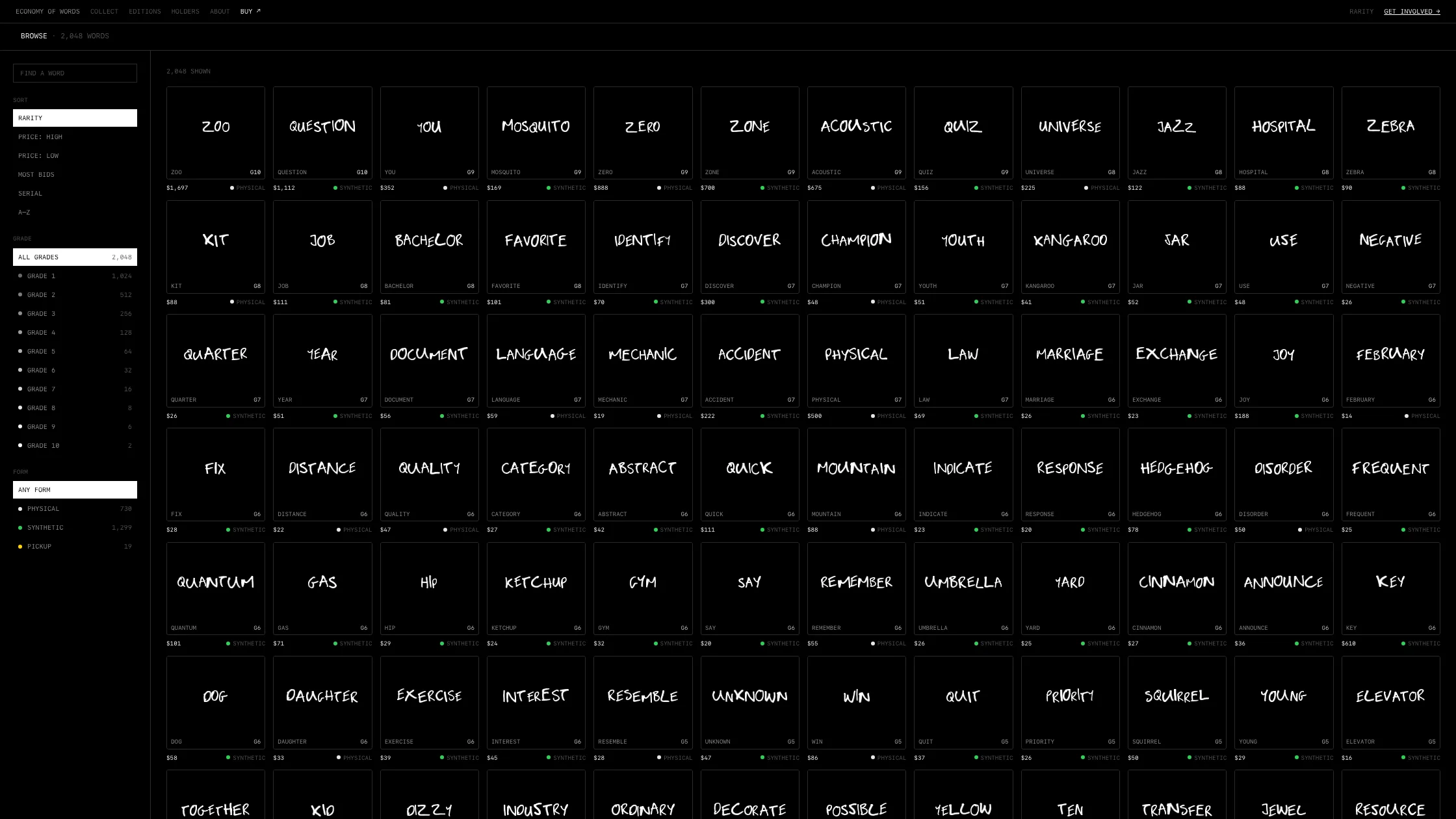
Economy of Words (2026) assigns a card to each of the 2,048 words in the English BIP39 list. Mechanical grades establish one hierarchy; individual auctions and the choice of a physical or digital card establish others.
Why these words
BIP39 specifies how mnemonic word sequences can encode information used to generate wallet keys. The English list has 2,048 entries. An isolated word on one of these cards is not itself money or a wallet key.
The work removes the words from their technical sequence and asks what associations a person brings to each one. This differs from ranking them by their role in the specification.
Sources: BIP 39 — Mnemonic code for generating deterministic keys
Grading and bidding
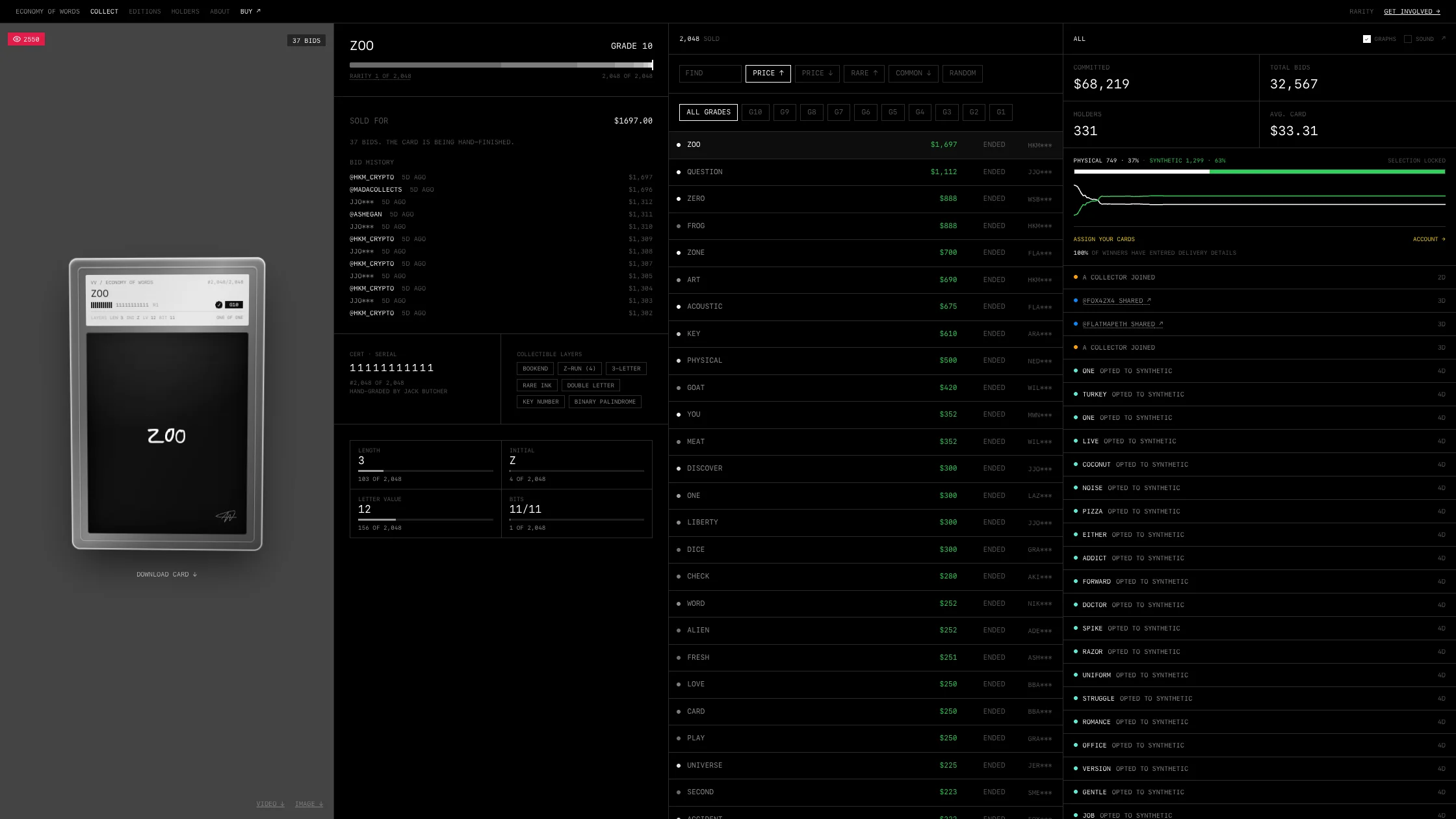
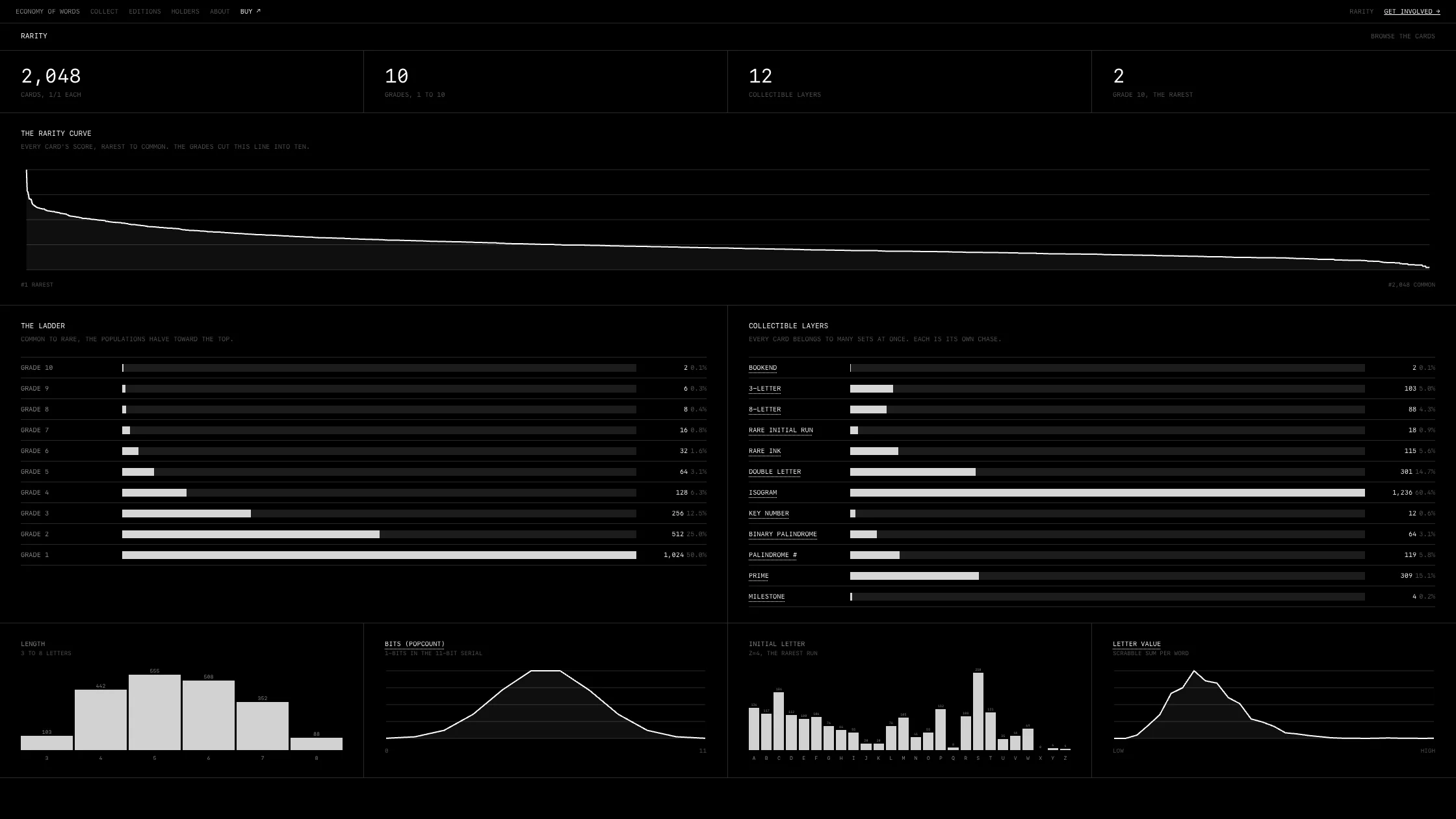
The project documentation describes scores based on word length, initial letter, letter value and list position. Ten grade bands turn these measures into rarity. The grade represents a rule, not an appraisal of the drawing’s condition.
Each auction opened at $1 and ran for 20 hours and 48 minutes, with extensions for late bids. Participants could value a word for reasons the grading system could not capture.
Sources: What it is · Economy of Words
Choosing a material form
The studio offered winners 2,048 minutes after closing to choose between a physical card and a synthetic version on Ethereum. The choice then locked. This makes material form part of the collector’s decision, rather than treating the digital work only as a receipt for a physical object.
Sources: Economy of Words — Preserved studio catalogue excerpts
Reading the different records
The auction explanation and later studio account describe different stages. The later account also describes wear appearing on synthetic holders as cards change hands. A versioned rendering record is needed before that behavior can be documented here as a verified mechanism. Final auction totals and the physical/digital split are omitted pending a reconciled results export.
Development
The studio catalogues the word-card project and its auction procedure. Source
Images
Selected images from the artist’s project archive. Captions describe the images; they do not assign unverified photography credits.
Sources and further reading
Artist statements describe intention. Reporting and interviews record different perspectives; exhibition announcements establish specific presentations. How sources are classified.
Artist / studio · Preserved primary-source excerpts
Economy of Words — Preserved studio catalogue excerpts
Selected passages from the public catalogue before this editorial revision. These preserve the artist’s account; their inclusion is not independent corroboration. The capture date is not the work’s creation date.
Artist / studio · Project rules and artist statement
What it is · Economy of Words
Explains scoring and the auction design. It contains launch-stage language and should not be read as a final results ledger. Its 2018 date for Visualize Value conflicts with the existing portfolio and AOTM’s 2019 account.
Technical reference · Technical specification
BIP 39 — Mnemonic code for generating deterministic keys
Supports the explanation of mnemonic encoding and word lists. It does not establish broader claims about the scope of digital money.